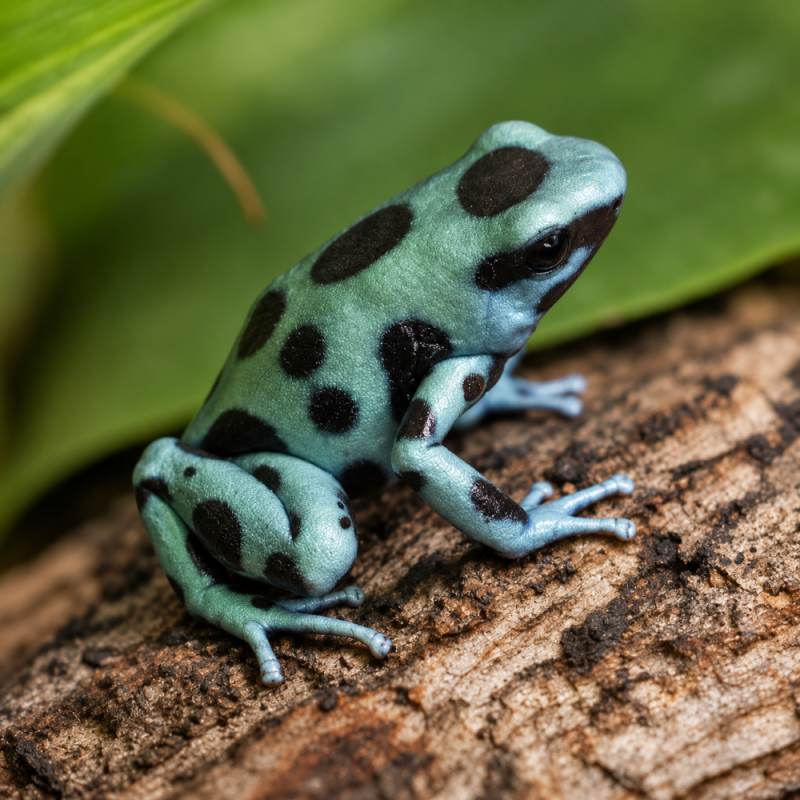
Dendrobates auratus ‘Bronze Birkhahn’ is a beautiful tropical dart frog belonging to a historic Panamanian lineage introduced into Europe in 1992. Its magnificent bronze and copper tones contrast with green, blue to turquoise markings and may develop striking silvery reflections with age. An outstanding collector dart frog for bioactive tropical terrariums and enthusiasts of historic captive lineages.

Security policy


Satisfaction guaranteed or your money back
 Free shipping on orders over €59
Delivery throughout Europe in 48 hours.
Dendrobates auratus ‘Bronze Birkhahn’ is a beautiful tropical collector dart frog belonging to a historic lineage of Dendrobates auratus originating from Panama.
It stands out for its magnificent metallic bronze coloration, copper tones and irregular green, blue to turquoise markings. This combination of colours gives the frog a particularly elegant and distinctive appearance.
Its diurnal activity, fascinating breeding behaviour and historical significance make it particularly attractive to amphibian enthusiasts and keepers of bioactive tropical terrariums.
Dendrobates auratus is naturally distributed throughout Central America and northwestern South America, including Nicaragua, Costa Rica, Panama and Colombia.
The Bronze Birkhahn lineage is historically associated with Panamanian specimens imported into Germany in 1992 by Holger Birkhahn and Klaus Wassmann.
The descendants of these animals established several captive lines historically known as Birkhahn, Wassmann, Bronce or Panama Special.
Bronze-coloured populations are known from the Caribbean slopes of Coclé Province in Panama. However, the exact natural locality of the founding specimens remains uncertain.
Dendrobates auratus primarily inhabits tropical forests, where it lives among leaf litter, roots, mosses and low-growing vegetation.
It appreciates environments offering regular humidity, numerous hiding places, dense vegetation and sheltered microhabitats.
Dendrobates auratus ‘Bronze Birkhahn’ displays a beautiful combination of bronze, brown and copper tones contrasted by green, blue or turquoise markings.
These markings may appear as irregular spots, bands or marbled patterns, whose distribution naturally varies between individuals.
An interesting feature of this lineage is the evolution of its coloration as the frog matures. Bronze tones may gradually lighten with age, developing beautiful metallic to silvery reflections in certain individuals.
Each frog therefore has a unique appearance.
Indicative adult size: 3 to 4.5 cm.
Adult females are generally larger and more robust than males.
In captivity, Dendrobates auratus may reach an indicative lifespan of 10 to 15 years, depending on husbandry, nutrition and overall health.
Dendrobates auratus is a diurnal, primarily terrestrial species that also climbs opportunistically.
The Bronze Birkhahn lineage has a reputation among dart frog enthusiasts for being relatively bold, although behaviour varies between individuals and their environment.
It regularly explores the terrarium floor, leaf litter, natural wood and decorative structures in search of small live prey.
A densely planted environment with numerous hiding places encourages natural behaviour.
This dart frog requires a humid tropical terrarium with adequate ventilation, dense planting and stable biological conditions.
A bioactive setup recreating the different layers of the tropical forest floor is particularly recommended.
Generous floor space remains particularly important for this primarily terrestrial species.
Use a tropical bioactive substrate capable of retaining regular moisture while maintaining good aeration.
A drainage layer combined with natural leaf litter helps recreate the forest floor and encourages beneficial microfauna.
Springtails and small isopods contribute to organic matter decomposition and the biological balance of the terrarium.
Dendrobates auratus is sensitive to excessive temperatures. Avoid prolonged temperatures above 27°C and provide suitable cooling solutions when summer conditions require them.
A slight nighttime temperature reduction helps recreate natural environmental fluctuations.
Recommended humidity: 75% to 95%, with natural fluctuations throughout the day.
Regular misting maintains suitable humidity and small water reservoirs within bromeliads.
Adequate ventilation is essential. The substrate should not remain permanently waterlogged.
Provide LED lighting suitable for tropical plant growth, with a photoperiod of approximately 12 hours per day.
Low-intensity UVB lighting may also be provided, following appropriate installation distances and maintaining sufficient shaded areas.
Dendrobates auratus ‘Bronze Birkhahn’ is an insectivorous frog feeding primarily on small live prey.
Regular and appropriate supplementation with calcium, vitamins and vitamin D3 is essential to prevent nutritional deficiencies.
Supplementation should take into account the frog's age, diet and UVB exposure.
Juveniles generally require daily feeding. Adult feeding frequency and quantities should be adjusted according to body condition.
Dendrobates auratus can be maintained in pairs or small groups in sufficiently spacious and appropriately structured terrariums.
Territorial behaviour and interactions between individuals should be monitored, particularly during breeding periods.
Keeping the Bronze Birkhahn lineage separately from other Dendrobates auratus morphs is strongly recommended to preserve its identity and historical characteristics.
Housing with other dart frog species is not recommended.
Adult females are generally larger, broader and more rounded than males.
Males produce a quiet call, particularly during breeding periods.
Sexing juveniles remains difficult and cannot be guaranteed before sexual maturity.
Dendrobates auratus ‘Bronze Birkhahn’ can reproduce in captivity when suitable husbandry and nutritional conditions are provided.
The female deposits her eggs in a humid, protected location, generally beneath a leaf or inside a breeding shelter.
The male participates in parental care and transports the tadpoles after hatching to suitable water reservoirs.
The tadpoles develop until metamorphosis into small terrestrial frogs.
Juvenile coloration gradually changes as the frogs develop. Their bronze and metallic tones may become more pronounced or lighten with age.
In their natural habitat, poison dart frogs accumulate toxic alkaloids primarily through their diet.
Captive-bred individuals fed exclusively on cultured insects generally do not develop this natural toxicity.
Handling should nevertheless be restricted to essential situations to protect their sensitive skin and minimise stress.
Dendrobates auratus is listed under CITES Appendix II and Annex B of the European Union wildlife trade regulations.
Keeping, acquiring and transferring this species must comply with the wildlife regulations applicable in the owner's country.
Proof of legal origin and transfer documentation must be retained.
Commercial breeding and sales may be subject to additional authorisation requirements.
Dendrobates auratus ‘Bronze Birkhahn’ stands out for its exceptional metallic coloration, historic lineage and fascinating colour development throughout its life.
Its bronze, copper and turquoise tones contrast beautifully with tropical mosses, ferns, bromeliads and natural leaf litter in bioactive terrariums.
A true living jewel for amphibian enthusiasts seeking to preserve the diversity of Dendrobates auratus morphs.
Before acquiring dart frogs, ensure that the terrarium is fully established, biologically stable and sufficiently planted.
Maintain a reliable supply of live food and provide a suitable solution for controlling temperatures during hot summer periods.
Keeping different lineages separately is essential for preserving their individual characteristics and passing them on to future generations.

Specific References
Dendrobates auratus ‘Bronze Birkhahn’ is a beautiful tropical dart frog belonging to a historic Panamanian lineage introduced into Europe in 1992. Its magnificent bronze and copper tones contrast with green, blue to turquoise markings and may develop striking silvery reflections with age. An outstanding collector dart frog for bioactive tropical terrariums and enthusiasts of historic captive lineages.