- New

Security policy


Satisfaction guaranteed or your money back
 Free shipping on orders over €59
Delivery throughout Europe in 48 hours.
Labisia sp. is an unusual tropical understory plant particularly well suited to humid terrariums. Its ornamental foliage, naturally compact habit and preference for warm humid conditions make it an excellent choice for dense naturalistic displays.
The abbreviation “sp.” indicates that the plant is confidently identified as belonging to the genus Labisia, while the exact species remains undetermined. JungleBox deliberately retains this identification rather than assigning a species without botanical confirmation.
Primulaceae
Labisia
Labisia sp. – unidentified species
The plant is identified only to genus level. The abbreviation “sp.” indicates that its exact species remains undetermined.
The genus Labisia occurs naturally across tropical Asia and Melanesia, from Indo-China to New Guinea.
Several species inhabit humid tropical forests, particularly shaded environments close to the forest floor.
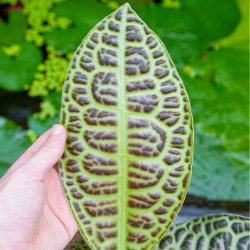
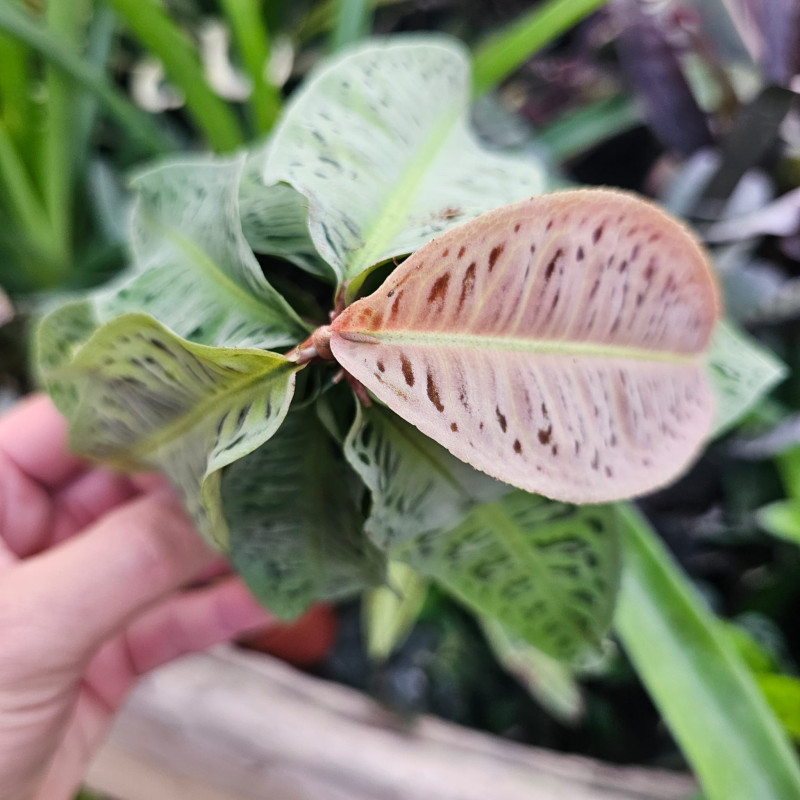
Labisia sp. is primarily grown for its ornamental foliage. Depending on the cultivated form, leaves may display deep green tones, lighter markings, contrasting veins or distinctive textures.
Because the exact species is unknown, leaf shape, colour and mature size may vary between clones and geographical forms.
Labisia cultivated in terrariums generally develops a compact to slightly spreading habit that works particularly well in forest-floor displays.
Growth remains relatively restrained, making the plant suitable for foreground and midground planting.
Use a light, humus-rich and free-draining substrate that retains consistent moisture without becoming compact or permanently saturated.
A mix containing coco fibre or coco humus, perlite, fine bark and sphagnum moss works particularly well.
Keep the growing medium consistently lightly moist.
Avoid both complete drying and stagnant water around the roots. In terrariums, a fresh but aerated substrate is generally preferable to permanently saturated conditions.
Humidity of approximately 70% to 90% is particularly suitable.
High humidity promotes healthy foliage, although a minimum level of airflow should always be maintained.
Ideal growing temperature: approximately 20°C to 27°C.
Avoid prolonged cold conditions and sudden temperature changes.
Labisia sp. prefers soft to medium filtered light.
Excessively strong light may damage the foliage. Diffused lighting more closely reproduces tropical forest-floor conditions.
Growth is generally slow to moderate.
This restrained development is especially useful in terrariums, where the plant can maintain a natural appearance without requiring frequent pruning.
Species of Labisia are flowering plants in the Primulaceae family and may produce small, relatively inconspicuous inflorescences.
In cultivation, however, the main ornamental feature is the foliage.
Depending on the cultivated form, propagation may be carried out by division, separating offsets or by stem cuttings when the plant structure allows it.
Remove old or damaged leaves and keep the foliage clean.
Avoid excessive direct misting when airflow inside the terrarium is limited.
Use a very dilute tropical plant fertiliser during active growth.
In terrariums, light and infrequent feeding is generally sufficient.
Labisia sp. offers exactly what many naturalistic terrariums need: a low, graphic and distinctly forest-like plant that immediately creates the impression of genuine tropical understory vegetation.
Positioned among mosses, dark natural roots and small ferns, it creates dense layered planting without unnecessarily filling the upper levels of the display.
Place it in a shaded to semi-shaded area with fresh, organic-rich substrate. It is particularly effective beneath a root or taller plant, where filtered light and high humidity recreate its natural forest-floor atmosphere.

Specific References
You might also like