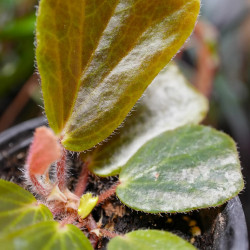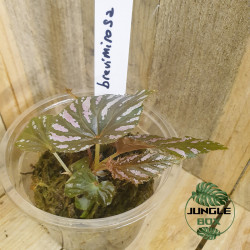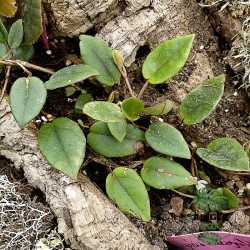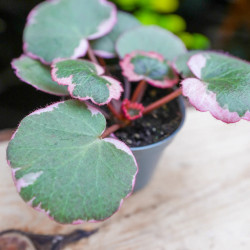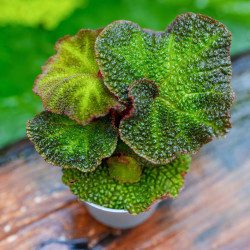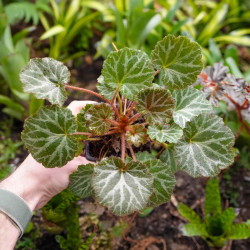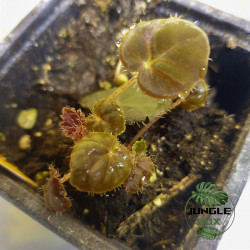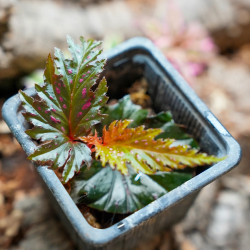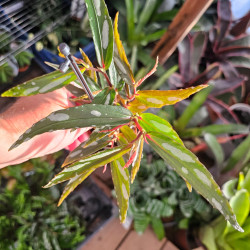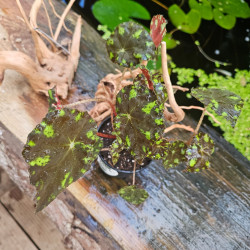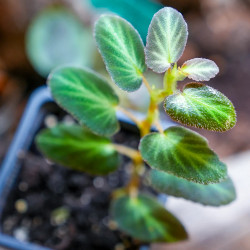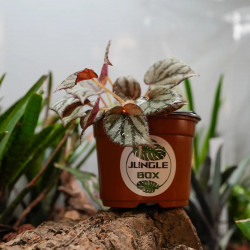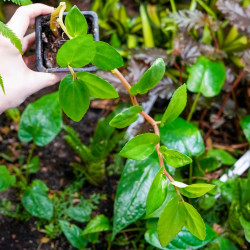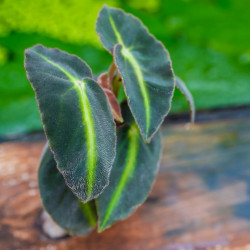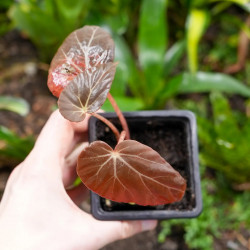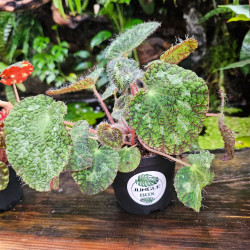
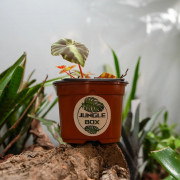
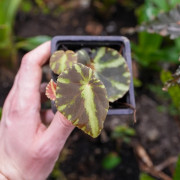
A rare compact botanical Begonia perfectly suited to humid terrariums. Endemic to Palawan, Begonia cleopatrae develops a low creeping habit with small green leaves patterned in brownish purple and often held close to the growing surface. An excellent species for nano terrariums, foreground planting and natural tropical displays.

Security policy


Satisfaction guaranteed or your money back
 Free shipping on orders over €59
Delivery throughout Europe in 48 hours.
Begonia cleopatrae is a small and highly distinctive botanical species especially well suited to humid tropical terrariums. Endemic to Palawan in the Philippines, it develops a low creeping habit with leaves held close to the growing surface, creating a very natural forest-floor or wet-rock appearance.
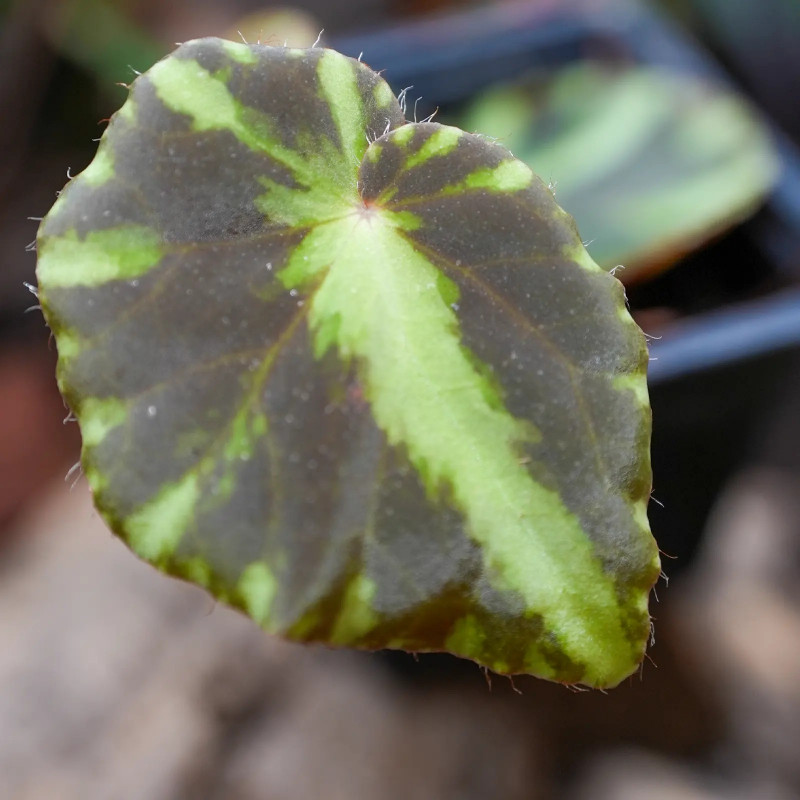
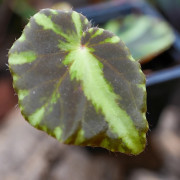
Its pale to medium green foliage, marked with brownish-purple patterns and often lighter along the midrib, brings a refined botanical look to small tropical displays.
Begoniaceae
Begonia
Begonia cleopatrae Coyle
This is a botanical species described in 2010. It should not be confused with the horticultural cultivar Begonia ‘Cleopatra’, which is a different plant.
Begonia cleopatrae is endemic to Palawan in the Philippines and is particularly associated with the Cleopatra’s Needle area.
In nature it grows as a rhizomatous lithophyte in humid, shaded tropical environments, especially on rocky surfaces.
The leaves are relatively small, ovate to broadly ovate, slightly asymmetrical and often held close to the growing surface.
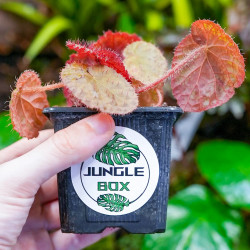
Foliage ranges from pale to medium green with brownish-purple markings and a generally paler midrib. The underside may develop an attractive reddish colour.
Petioles and other parts of the plant may carry fine reddish-brown hairs, adding further botanical character.
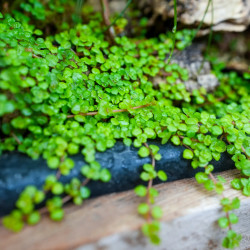
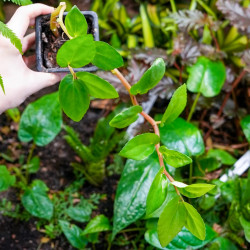
Begonia cleopatrae has a low, creeping and rhizomatous habit. Its thin stems can root at the nodes and gradually spread across the substrate or rocky surfaces.
The plant remains naturally compact, making it an excellent choice for nano and small terrariums.
This species appreciates indirect to subdued light, high humidity and a light growing medium kept consistently lightly moist.
It performs particularly well in terrariums where humidity remains stable. Gentle airflow is still recommended to avoid completely stagnant conditions.
Its low creeping growth makes it ideal for foreground planting, around rocks, at the base of natural wood or in cooler humid areas of the display.
Use a light, humus-rich and airy substrate containing coco humus, perlite, fine bark and optionally a small amount of sphagnum.
The growing medium should remain lightly moist without becoming dense or waterlogged.
Keep the substrate consistently lightly moist.
Avoid both prolonged drying and stagnant water. Soft, low-mineral water is recommended.
Begonia cleopatrae appreciates high humidity, ideally around 70% to 90%.
It performs especially well in closed or semi-closed terrariums with relatively stable atmospheric moisture.
Ideal growing temperature: 20°C to 26°C.
Avoid prolonged cold conditions and excessive heat combined with poor ventilation.
Growth is moderate. The plant gradually spreads through its creeping stems and may form a compact low carpet.
Growth can be faster in terrariums than under standard indoor conditions because of the more stable humidity.
Sold as a young plant. Plant size and development may vary depending on season and availability.
Remove old or damaged leaves and trim stems if the plant begins to spread beyond the desired area.
Light pruning helps maintain a dense compact habit.
Begonia cleopatrae stands out for its miniature size, creeping habit and naturally patterned foliage.
Unlike many horticultural Begonia, it is a true botanical species endemic to Palawan, making it especially attractive for naturalistic terrariums and botanical Begonia collections.

Specific References
You might also like
A rare compact botanical Begonia perfectly suited to humid terrariums. Endemic to Palawan, Begonia cleopatrae develops a low creeping habit with small green leaves patterned in brownish purple and often held close to the growing surface. An excellent species for nano terrariums, foreground planting and natural tropical displays.