- New


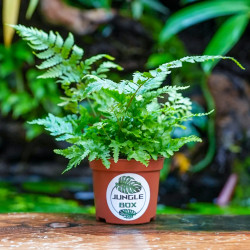
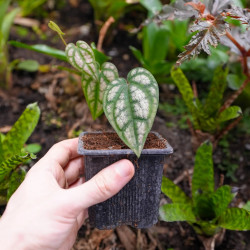
A tiny fern with the look of a miniature palm: Actiniopteris australis develops delicate, deeply divided fan-shaped fronds. Supplied in a 6 cm pot, it fits perfectly between natural roots, rocks and mosses, adding graphic texture without taking over the display.

Security policy


Satisfaction guaranteed or your money back
 Free shipping on orders over €59
Delivery throughout Europe in 48 hours.
Actiniopteris australis is an unusual small fern instantly recognisable by its fan-shaped fronds, deeply divided into fine radiating segments.
Supplied in a Ø 6 cm pot, its compact size makes it particularly well suited to small planted displays, tropical terrariums and foreground planting. Its delicate foliage resembles a miniature palm and adds a highly graphic silhouette to the display.
Pteridaceae
Actiniopteris
Actiniopteris australis (L.f.) Link
Ø 6 cm
Actiniopteris australis is an island species native to Mauritius and Réunion in the Indian Ocean.
The fronds are narrow at the base before opening into a fan and dividing deeply into fine radiating segments.
This unusual architecture gives the plant a miniature, almost sculptural appearance quite unlike conventional long-fronded ferns.
Actiniopteris australis remains compact and develops from a short rhizome.
It gradually forms a small clump of upright to slightly spreading fronds, ideal for foreground and midground planting.
Use a light, aerated and highly free-draining mix containing coco fibre, perlite, fine bark and mineral components.
Unlike some moisture-loving ferns, Actiniopteris australis prefers a lightly moist but well-aerated substrate rather than permanently saturated conditions.
Maintain light substrate moisture during active growth while allowing the surface to dry slightly between waterings.
Avoid permanently saturated conditions and stagnant water around the rhizome.
Humidity of approximately 55% to 80% is suitable.
Good airflow is recommended, particularly in enclosed terrariums.
Ideal growing temperature: approximately 18°C to 26°C.
Avoid prolonged cold conditions and sudden temperature changes.
Actiniopteris australis prefers medium to fairly bright filtered light.
Adequate lighting helps maintain compact, well-shaped fronds. Avoid harsh direct sunlight through glass.
Slow to moderate growth. Its naturally restrained size makes it particularly useful for smaller planted displays.
Like all ferns, Actiniopteris australis does not produce flowers or seeds. It reproduces naturally through spores formed on fertile fronds.
Remove older fronds as they naturally dry.
Avoid burying the rhizome too deeply and maintain good airflow around the plant.
Nutritional requirements are low. A very dilute tropical plant fertiliser may occasionally be used during active growth.
Avoid concentrated feeding as the roots of small ferns can be sensitive to excessive mineral salts.
With fronds divided like miniature fans, Actiniopteris australis offers a completely different architecture from conventional ferns.
Supplied in a 6 cm pot, it fits beautifully between rocks, at the base of natural roots or among mosses, creating an unusual focal point without overwhelming the display.
Place it in a bright, well-drained area rather than the wettest section of the terrarium. A slightly elevated position among rocks or beside a natural root beautifully showcases its unusual fan-shaped foliage.

Specific References
You might also like
A tiny fern with the look of a miniature palm: Actiniopteris australis develops delicate, deeply divided fan-shaped fronds. Supplied in a 6 cm pot, it fits perfectly between natural roots, rocks and mosses, adding graphic texture without taking over the display.