- New
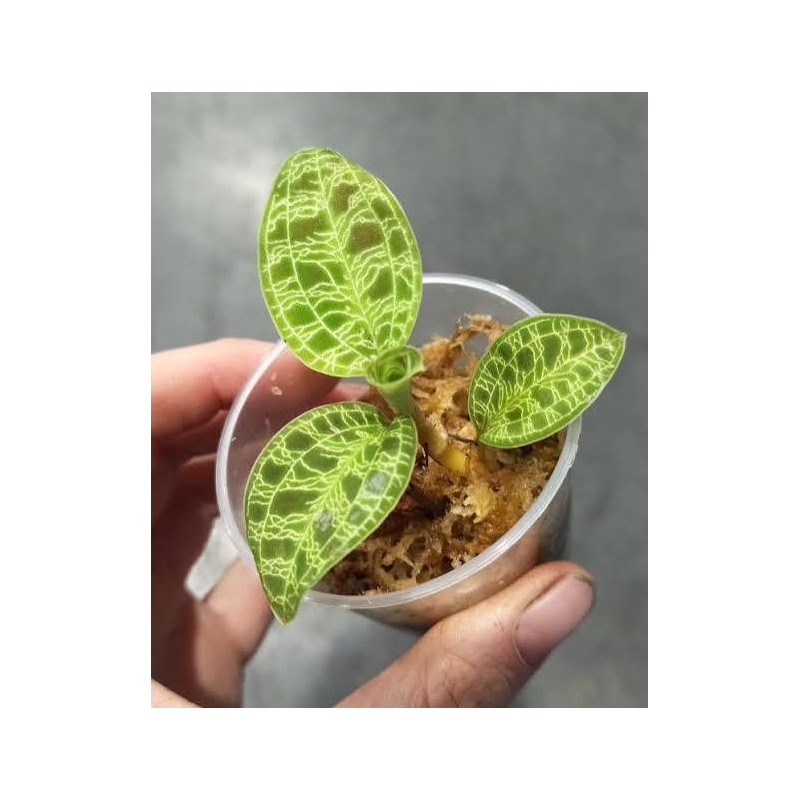
Macodes petola, or Jewel Orchid, is a compact tropical terrestrial orchid with deep green leaves covered in striking golden metallic veins. Ideal for humid tropical terrariums, emerged paludarium areas and rainforest-style planted displays.

Security policy


Satisfaction guaranteed or your money back
 Free shipping on orders over €59
Delivery throughout Europe in 48 hours.
Macodes petola, commonly known as a jewel orchid, is a tropical terrestrial orchid grown primarily for its spectacular foliage. Its deep green leaves are covered with a fine network of golden to copper-coloured veins that appear almost metallic under the light.
Unlike orchids mainly cultivated for their flowers, Macodes petola is especially valued for the intricate and jewel-like appearance of its foliage. Its compact size and preference for warm, humid conditions make it an excellent choice for tropical terrariums and rainforest-style planted displays.
Orchidaceae
Macodes
Macodes petola
Jewel Orchid
Macodes petola originates from humid tropical forests of Southeast Asia, where it grows terrestrially in humus, moss and decomposing organic material on the forest floor.
The foliage is the most distinctive feature of this orchid. The leaves are oval, velvety and deep green, covered with an extremely fine network of golden, copper to slightly orange veins.
Under angled light, these veins can appear almost sparkling, giving the plant its characteristic jewel-like appearance.
Macodes petola remains relatively compact. It produces short creeping stems that gradually develop into a small clump.
Its low growth habit makes it particularly suitable for foreground and midground planting in humid tropical terrariums.
Macodes petola is primarily a terrestrial orchid. It prefers a light, organic and aerated substrate rather than mounted cultivation typical of many epiphytic orchids.
The crown and creeping stems should not be buried too deeply to reduce the risk of rot.
Use a light, organic and free-draining substrate containing sphagnum moss, fine coco fibre, fine bark, perlite and well-decomposed organic matter.
The growing medium should remain lightly moist but never waterlogged.
Maintain regular substrate moisture without soaking it. Allow the surface layer to begin drying slightly before watering again.
Soft or low-mineral water is preferable.
Humidity of approximately 70% to 90% is particularly suitable for Macodes petola.
Some airflow remains important to prevent permanently stagnant moisture around the leaves and crown.
Ideal growing temperature: approximately 20°C to 27°C.
Avoid prolonged low temperatures and major temperature fluctuations.
Macodes petola prefers soft to medium filtered light.
It does not require intense lighting. Excessive light may fade or damage the foliage, while softer lighting helps preserve its deep green colour and brilliant vein pattern.
Slow to moderate growth. The plant gradually spreads through creeping stems and can develop multiple shoots over time.
Macodes petola can produce slender flower spikes bearing small pale flowers, usually brownish, cream to whitish.
Flowering is secondary, as this orchid is primarily grown for its exceptional foliage.
Propagation can be carried out by division or from sections of sufficiently developed creeping stems.
Remove damaged leaves and avoid allowing water to remain on the foliage for long periods.
Good airflow, a light substrate and stable humidity are key to healthy growth.
Use a very weakly dosed orchid or tropical plant fertiliser occasionally during active growth.
Macodes petola responds better to light feeding than to heavy fertilisation.
Macodes petola is a genuine collector orchid. Its dark foliage covered with golden veins creates a spectacular effect even when the plant is not flowering.
Its compact size and love of humidity also make it an excellent choice for enriching the lower levels of tropical terrariums.
Place Macodes petola in the foreground or in a shaded area of the terrarium alongside mosses and small ferns.
Avoid positioning it directly beneath a powerful LED: soft diffused light highlights the golden leaf veins much more effectively.

Specific References
You might also like
Macodes petola, or Jewel Orchid, is a compact tropical terrestrial orchid with deep green leaves covered in striking golden metallic veins. Ideal for humid tropical terrariums, emerged paludarium areas and rainforest-style planted displays.