- New


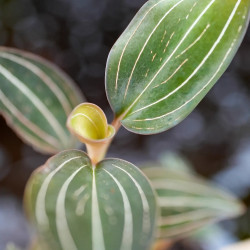
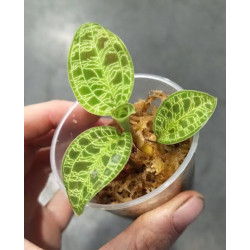
A true piece of living jewellery: Anoectochilus chapaensis develops very dark, almost black foliage crossed by a network of golden and copper veins that seems to glow under the light. Compact and terrestrial, this jewel orchid is perfect for creating an exceptional foreground among mosses, roots and small ferns.

Security policy


Satisfaction guaranteed or your money back
 Free shipping on orders over €59
Delivery throughout Europe in 48 hours.
Anoectochilus chapaensis is a terrestrial jewel orchid prized for its dark foliage crossed by fine golden to copper-coloured veins. Unlike orchids grown mainly for their flowers, this species is primarily valued for its extraordinary leaves, which appear almost threaded with metallic lines.
Compact, delicate and naturally adapted to humid forest-floor conditions, it is an excellent collector plant for tropical terrariums, orchidariums and planted displays where a low-growing, highly graphic species is required.
Orchidaceae
Anoectochilus
Anoectochilus chapaensis Gagnep.
Terrestrial rhizomatous jewel orchid
Anoectochilus chapaensis is native from southern China to northern Indo-China, including southeastern Yunnan, Myanmar and Vietnam.
It naturally grows in humid forests where it benefits from filtered light, high atmospheric humidity and organic-rich forest substrates.
The foliage is the main ornamental feature of the species. Leaves are oval to slightly oblique and deep green, sometimes appearing almost black under certain lighting conditions.
The leaf surface is crossed by fine luminous veins ranging from golden and copper to reddish tones, creating a striking contrast.
Depending on the angle of the light, the veins develop metallic reflections and may appear almost embroidered with fine threads of gold or copper.
This distinctive foliage places Anoectochilus chapaensis among the most attractive jewel orchids.
The plant develops a low compact habit with slightly ascending stems carrying several leaves towards the upper section.
It gradually spreads through a terrestrial rhizome and can form attractive small clumps over time.
Use a light, organic-rich and highly aerated substrate that retains consistent moisture without becoming compact.
A mixture containing finely chopped sphagnum moss, coco humus, fine bark and perlite works particularly well.
A surface layer of living moss may also help maintain fresh humid conditions around the rhizome.
Keep the growing medium consistently lightly moist during active growth without leaving it waterlogged.
Avoid strong cycles between complete drying and saturation.
Humidity of approximately 70% to 90% is particularly suitable.
High humidity should always be combined with regular airflow to reduce the risk of crown and foliage rot.
Ideal growing temperature: approximately 18°C to 24°C.
This species prefers mild to warm conditions and generally benefits from slightly cooler temperatures than many lowland tropical orchids.
Anoectochilus chapaensis prefers low to medium filtered light.
Excessively strong light may fade or damage the foliage, while gentle lighting enhances the contrast between the dark leaves and metallic veins.
Slow to moderate growth.
Under favourable conditions, new shoots gradually develop from the rhizome and form a denser clump.
Mature Anoectochilus chapaensis may produce an upright inflorescence carrying several small successive flowers.
Flowering is generally secondary to the exceptional ornamental value of the foliage.
Propagation may be carried out by dividing the rhizome or separating stem sections containing several nodes and a viable growing point.
Remove only old or damaged foliage and avoid keeping the leaves permanently wet where airflow is limited.
Maintain consistent substrate moisture without allowing water to accumulate around the base of the plant.
Use a very dilute orchid fertiliser during active growth.
Light occasional feeding is preferable to concentrated applications, as the fine roots can be sensitive to salt build-up.
With this orchid, the foliage steals the show: almost-black leaves are crossed by golden and copper lines that seem to glow under the light.
Its compact growth makes it easy to combine with mosses, small ferns, roots and natural décor to create a miniature tropical forest floor.
Place it in a cool, shaded and humid section of the terrarium, ideally in the foreground or at the base of a root. Soft light coming slightly from the side will enhance the metallic reflections of the veins.

Specific References
You might also like
A true piece of living jewellery: Anoectochilus chapaensis develops very dark, almost black foliage crossed by a network of golden and copper veins that seems to glow under the light. Compact and terrestrial, this jewel orchid is perfect for creating an exceptional foreground among mosses, roots and small ferns.