- New
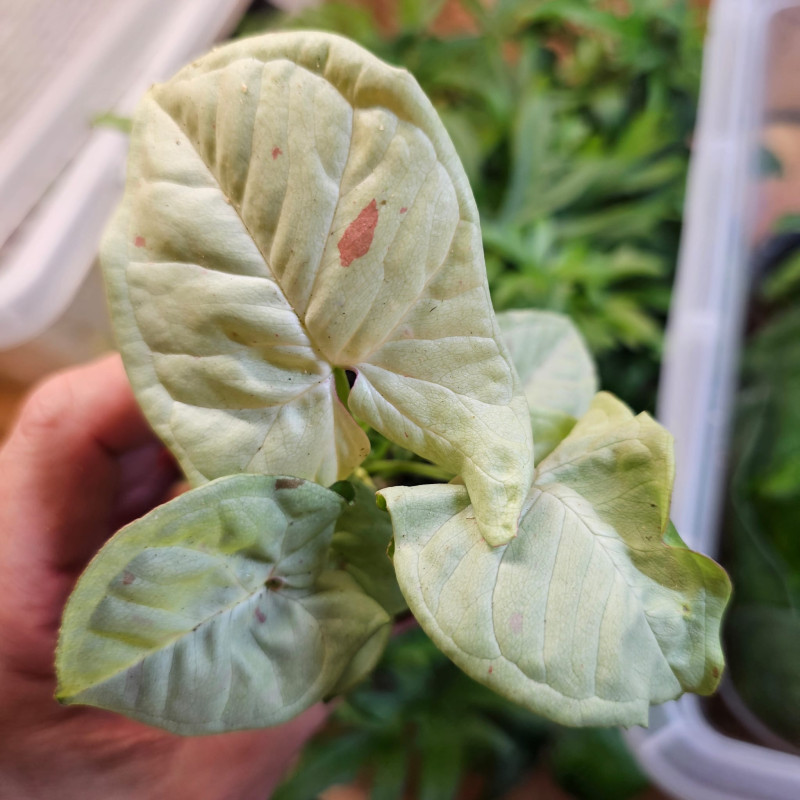
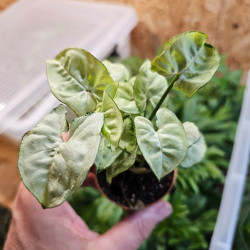
Like tiny pink confetti scattered across pale green foliage: Syngonium 'Confetti' produces leaves with a unique pattern every time. Compact while young and increasingly climbing with maturity, it adds a soft splash of colour around natural roots before gradually moving upwards through a tropical display.

Security policy


Satisfaction guaranteed or your money back
 Free shipping on orders over €59
Delivery throughout Europe in 48 hours.
Syngonium podophyllum 'Confetti' is an attractive tropical aroid prized for its pale foliage scattered with irregular pink markings. Each leaf looks as though it has been sprinkled with tiny pieces of colourful confetti, creating a delicate pattern that naturally varies from one leaf to another.
Compact while young and increasingly creeping or climbing with maturity, this Syngonium is particularly well suited to tropical terrariums, emerged paludarium sections and collections of unusual foliage aroids.
Araceae
Syngonium
Syngonium podophyllum
Syngonium podophyllum 'Confetti'
'Confetti' is a horticultural selection of Syngonium podophyllum originating from a mutation of 'Regina Red'. It was selected for its pale green to creamy foliage irregularly splashed and spotted with pink.
The number, size and distribution of the pink markings may naturally vary from leaf to leaf and according to light, temperature and growing conditions.
Juvenile leaves are arrow-shaped and range from pale green to creamy green, sometimes developing an almost silvery appearance under certain lighting conditions.
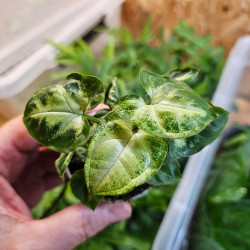
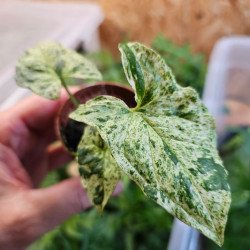
The leaf blade is scattered with small pink to salmon-pink markings. Some leaves may display abundant spotting while others develop a much subtler pattern.
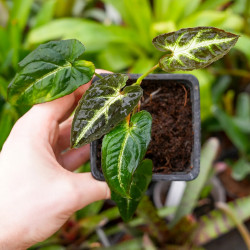
No two leaves develop exactly the same pattern. This natural irregularity is one of the main attractions of 'Confetti' and gives every new leaf its own character.
Bright filtered light generally helps maintain compact growth and enhances the contrast between the pale background and pink markings.
As with many Syngonium, leaf shape changes as the plant matures.
Juvenile leaves are simple and arrow-shaped, while mature specimens grown on a support may gradually produce larger and more divided foliage.
While young, Syngonium 'Confetti' forms a relatively compact, dense and well-branched clump.
As it matures, the stems lengthen and develop aerial roots, allowing the plant to creep or climb over natural wood, cork, climbing poles or planted backgrounds.
Regular pruning can also maintain a shorter and bushier plant.
Syngonium 'Confetti' is particularly effective for introducing a bright focal point into displays dominated by deeper green foliage.
It can be planted at the base of natural wood, among ferns, mosses or bromeliads, then gradually trained upwards as the stems begin to extend.
As it grows, the plant benefits from vertical supports that are slightly textured and retain a small amount of moisture.
Natural wood, cork, climbing poles or Hygrolon-covered backgrounds allow aerial roots to attach and gradually encourage more mature foliage.
Use a light, organic-rich, highly aerated and free-draining aroid substrate.
A mixture containing coco humus, coco chips, fine bark, perlite and a small amount of sphagnum moss works particularly well.
Keep the substrate lightly moist during active growth, allowing the upper layer to begin drying before watering again.
Avoid permanently saturated growing media and stagnant moisture around the roots.
Humidity of approximately 60% to 80% is particularly suitable.
Humid air encourages healthy foliage and aerial root development while adequate airflow should still be maintained.
Ideal growing temperature: approximately 18°C to 27°C.
Avoid prolonged temperatures below 15–16°C and cold draughts.
Syngonium 'Confetti' prefers medium to bright filtered light.
Good lighting helps maintain compact growth and strongly contrasted foliage. In excessive shade, plants may produce greener leaves and longer internodes.
Avoid harsh direct sunlight, which may scorch the paler and pink sections of the foliage.
Moderate to fast growth under warm, bright and humid conditions.
Once established, the plant regularly produces new foliage, extends its stems and can quickly begin covering a suitable vertical support.
Mature Syngonium may produce typical aroid inflorescences consisting of a spathe surrounding a spadix.
In indoor cultivation and terrariums, 'Confetti' is mainly valued for its decorative foliage.
Propagation is easily carried out from stem cuttings containing at least one viable node.
Cuttings can be rooted in sphagnum moss, moist substrate or water before planting.
Occasional pruning of elongated stems helps maintain a compact and well-branched plant.
Pruned sections can be reused as cuttings to thicken the plant or establish additional areas within the terrarium.
Use a balanced low-strength tropical plant or aroid fertiliser during active growth.
Feeding should remain light in bioactive terrariums.
Just as its name suggests, every leaf looks as though it has been sprinkled with tiny pieces of pink confetti. Against a pale green to creamy background, the random markings give the plant a soft, luminous and constantly changing appearance.
While young it forms a small decorative clump; as it matures it can climb natural wood or vertical backgrounds and develop into a true climbing aroid.
Place it in a bright position protected from direct sunlight. For larger mature foliage, allow selected stems to establish themselves on natural wood or another slightly moisture-retentive support.
If you prefer a compact clump, simply pinch back shoots as they begin to become too long.
Like other Araceae, Syngonium plants contain calcium oxalate crystals. The sap may be irritating and the plant should not be ingested.

Specific References
You might also like
Like tiny pink confetti scattered across pale green foliage: Syngonium 'Confetti' produces leaves with a unique pattern every time. Compact while young and increasingly climbing with maturity, it adds a soft splash of colour around natural roots before gradually moving upwards through a tropical display.