- New
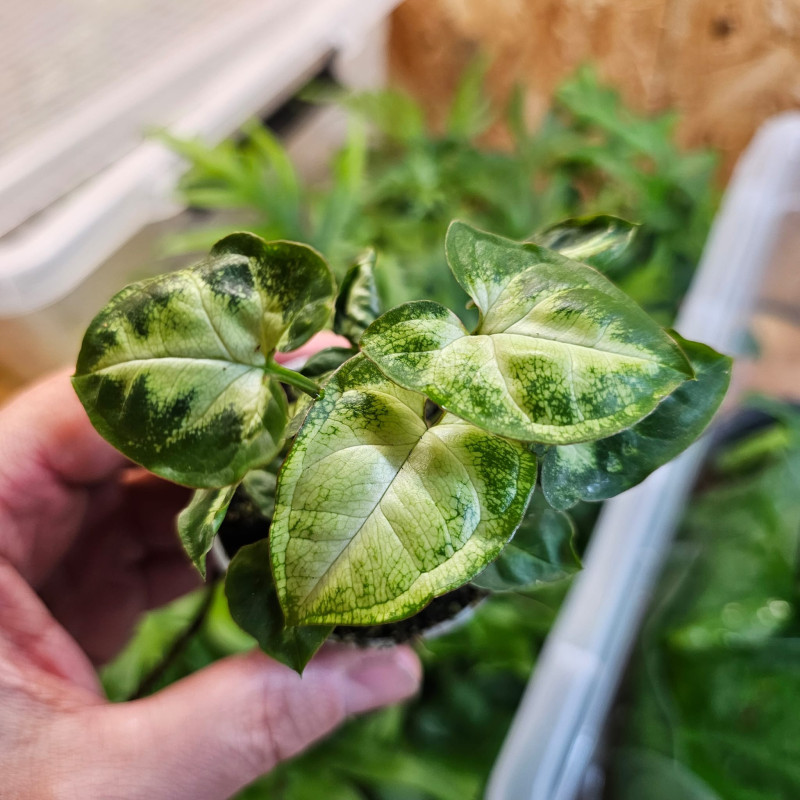
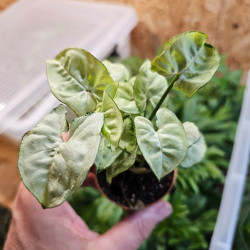
A miniature Syngonium made for compact tropical displays: 'Pixie' develops small dark green leaves illuminated by cream to pale green centres. Dense, compact and easy to trim, it instantly adds contrast around natural roots, mosses and terrarium foregrounds.

Security policy


Satisfaction guaranteed or your money back
 Free shipping on orders over €59
Delivery throughout Europe in 48 hours.
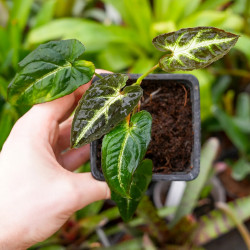
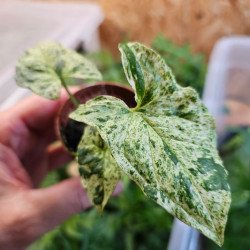
Syngonium 'Pixie' is a compact Syngonium cultivar with bright, highly contrasted foliage. Its small arrow-shaped leaves feature dark green margins surrounding a cream to pale green centre.
Its reduced size, dense growth and preference for humid conditions make it particularly well suited to tropical terrariums, emerged paludarium sections and compact planted displays.
Araceae
Syngonium
Syngonium podophyllum
Syngonium 'Pixie'
'Pixie' is a compact dwarf horticultural selection from the Syngonium podophyllum group, grown primarily for its small size and strongly contrasted variegated foliage.
Young leaves are small and arrow-shaped, with dark green margins surrounding a cream, pale green or whitish-green centre.
The contrast remains particularly striking under good filtered light and gives the plant a bright appearance despite its compact dimensions.
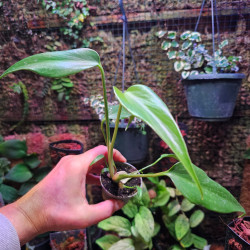
Syngonium 'Pixie' remains significantly more compact than standard Syngonium cultivars. It initially forms a dense clump and may gradually develop a more creeping or slightly climbing habit as it matures.
Regular pruning easily maintains a low compact form suitable for terrariums.
Its compact growth makes it possible to enjoy the distinctive Syngonium look in installations where standard cultivars would quickly become too large.
It works especially well at the base of natural wood, between stones or in the midground, where its pale foliage adds an immediate point of brightness.
Use a light, organic-rich and free-draining substrate that retains gentle moisture while allowing good airflow around the roots.
A mixture containing coco humus, coco chips, perlite, fine bark and a small amount of sphagnum moss works particularly well.
Keep the substrate lightly moist during active growth, allowing the surface to begin drying between waterings.
Avoid permanently saturated growing media and stagnant water around the roots.
Humidity of approximately 60% to 85% is particularly suitable.
Humid air encourages healthy foliage, provided adequate airflow is maintained.
Ideal growing temperature: approximately 20°C to 28°C.
Avoid prolonged exposure to low temperatures and cold draughts.
Syngonium 'Pixie' prefers medium to bright filtered light.
Good lighting helps maintain pale variegation and compact growth. In excessive shade, the foliage may become greener and the stems may stretch.
Avoid harsh direct sunlight, which may damage the paler sections of the leaves.
Moderate to relatively fast growth under warm, humid and bright conditions.
Despite this, the cultivar remains considerably more compact than standard Syngonium forms.
Mature Syngonium plants may produce typical aroid inflorescences consisting of a spathe and spadix.
In indoor cultivation and terrariums, 'Pixie' is primarily grown for its foliage.
Propagation is easily achieved from stem cuttings containing at least one viable node.
Cuttings root readily in moist substrate, sphagnum moss or water before planting.
Pinch or trim elongated stems to maintain a dense compact habit.
Pruned sections can be reused as cuttings to thicken the plant or establish additional areas within a terrarium.
Use a balanced low-strength tropical plant or aroid fertiliser during active growth.
Feeding should remain light in bioactive terrariums.
'Pixie' concentrates all the appeal of a Syngonium into a miniature format. Small dark green leaves illuminated by creamy centres create strong contrast without quickly overwhelming the layout.
It is an excellent choice for bringing the appearance of a climbing aroid into compact tropical terrariums and planted foregrounds.
Provide bright filtered light and regularly trim any stems that begin to elongate. This will maintain a dense miniature clump, ideal around natural roots or between larger tropical plants.
Like other Araceae, Syngonium plants contain calcium oxalate crystals. The sap may be irritating and the plant should not be ingested.

Specific References
You might also like
A miniature Syngonium made for compact tropical displays: 'Pixie' develops small dark green leaves illuminated by cream to pale green centres. Dense, compact and easy to trim, it instantly adds contrast around natural roots, mosses and terrarium foregrounds.