- New
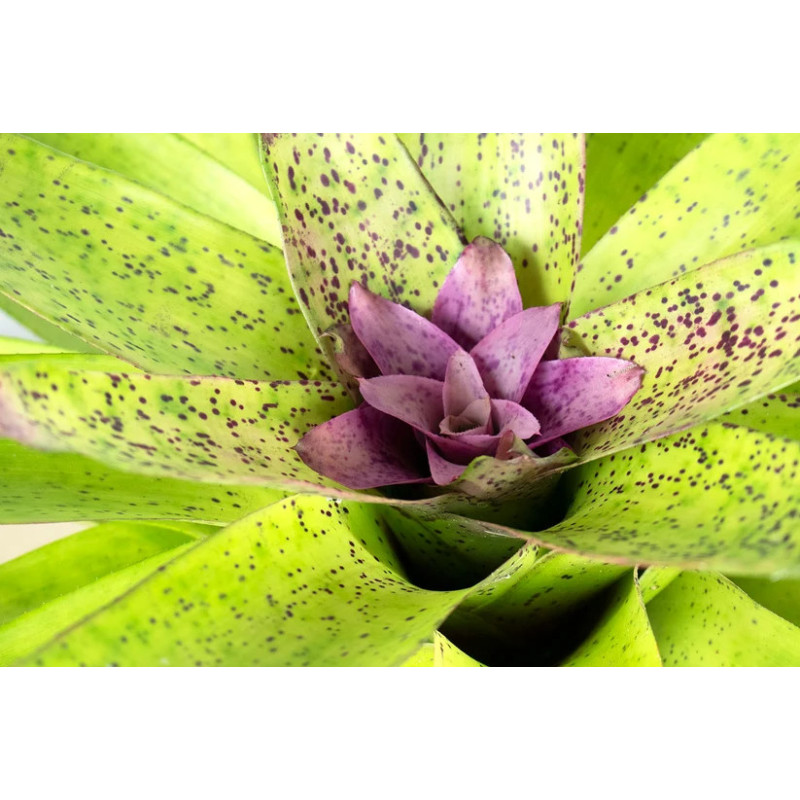
Nidularium 'Leprosa' is a horticultural cultivar with heavily spotted and mottled green foliage and a pink to red central flowering display. Ideal for humid tropical terrariums, paludariums and bromeliad collections.

Security policy


Satisfaction guaranteed or your money back
 Free shipping on orders over €59
Delivery throughout Europe in 48 hours.
Nidularium 'Leprosa' is a highly ornamental horticultural bromeliad valued for its strongly spotted and mottled green foliage and its colourful central inflorescence.
Its natural appearance, graphic foliage and broad structured rosette make it an excellent choice for medium to large humid tropical terrariums, paludariums, tropical greenhouses and Bromeliaceae collections.
Bromeliaceae
Nidularium
Nidularium 'Leprosa'
'Leprosa' is an old horticultural cultivar whose exact origin has long been debated. It has historically been associated with Nidularium rutilans and the former name Nidularium regelioides.
The name 'Leprosa' remains in horticultural use for this distinctive, heavily spotted form.
The related botanical species belong to the genus Nidularium, which is naturally associated with humid Atlantic Forest environments in Brazil.
These bromeliads typically grow in warm, humid and relatively shaded tropical forest conditions.
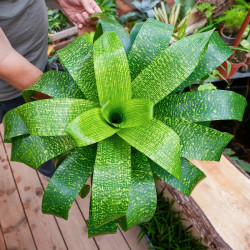
Nidularium 'Leprosa' forms a dense rosette of broad green leaves heavily marked with dark spots and irregular mottling.
This distinctive pattern gives the plant a highly graphic appearance and makes it easy to distinguish from plain green Nidularium forms.
The plant forms a broad, relatively low rosette typical of the genus Nidularium. Its habit is more spreading than that of many Aechmea or Neoregelia.
Over time, it can produce several offsets around the base and gradually develop into a dense and attractive clump.
Use a rich but highly aerated substrate containing fine bark, coco fibre or chips, perlite, volcanic rock, sphagnum moss and a small amount of organic material.
The mix should retain some moisture while remaining sufficiently free-draining to keep the roots well aerated.
Keep the substrate lightly moist and maintain a small amount of soft or low-mineral water in the central rosette.
Refresh the water regularly to prevent prolonged stagnation.
Nidularium 'Leprosa' appreciates high humidity, ideally around 70% to 90%.
This should always be combined with good airflow to reduce the risk of rot.
Ideal growing temperature: approximately 20°C to 27°C.
Avoid prolonged cold conditions and sudden temperature fluctuations.
This bromeliad prefers medium to bright filtered light.
Good light encourages compact growth and may enhance the contrast of the foliage. Avoid harsh direct sunlight, which can scorch the leaves.
Moderate growth. Once established, the plant gradually develops a broad rosette and can produce several offsets.
Flowering occurs directly in the centre of the rosette, as is typical of Nidularium.
The surrounding bracts can develop strong pink to red tones, creating a striking contrast with the spotted green foliage.
Propagation is mainly carried out by separating offsets once they have reached a suitable size.
Remove old or damaged leaves at the base and refresh the water held in the centre of the rosette regularly.
Avoid excessive organic debris or permanently stagnant water inside the central cup.
Use a weakly dosed fertiliser for bromeliads or tropical plants during active growth.
Avoid over-fertilisation and high mineral salt concentrations.
Nidularium 'Leprosa' stands out for its heavily spotted foliage and colourful central flowering display. Its more natural and wild appearance makes it especially appealing to bromeliad collectors.
It integrates particularly well into humid tropical forest-style displays where its broad rosette adds immediate volume and contrast.
Place Nidularium 'Leprosa' in a bright forest-floor style position with high humidity and good ventilation.
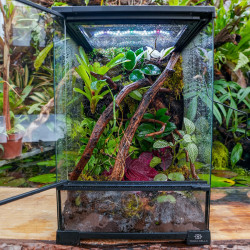
In a terrarium, it works especially well at the base of a large root or among ferns and creeping plants, where its spotted foliage creates a very natural contrast.
Specific References
Nidularium 'Leprosa' is a horticultural cultivar with heavily spotted and mottled green foliage and a pink to red central flowering display. Ideal for humid tropical terrariums, paludariums and bromeliad collections.