- New


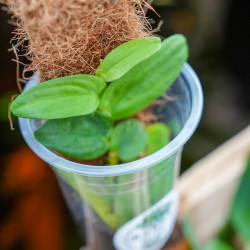
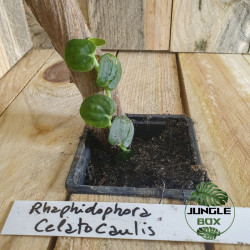
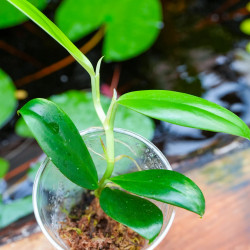
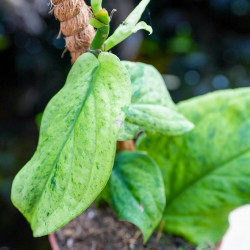
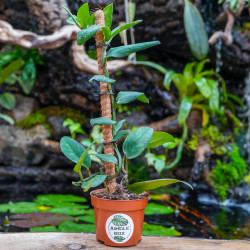
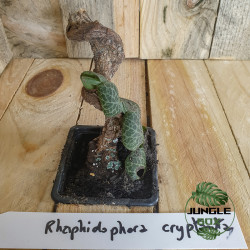
Rhaphidophora foraminifera 'Variegata' stands out with its cream-to-yellow variegated foliage and natural climbing habit. As it matures on a root or vertical support, the leaves can develop the characteristic perforations of the species. Supplied in a 9 cm pot, it is an excellent collector plant for adding depth and a true jungle feel to tropical terrariums and paludariums.

Security policy


Satisfaction guaranteed or your money back
 Free shipping on orders over €59
Delivery throughout Europe in 48 hours.
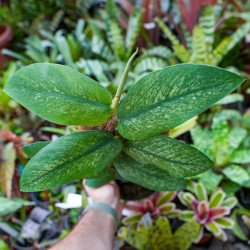
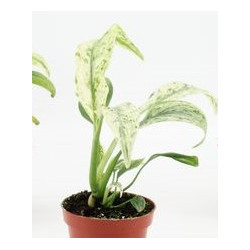
Rhaphidophora foraminifera 'Variegata' is a rare tropical climbing aroid valued for its green foliage irregularly variegated with cream to pale yellow. As the plant matures and climbs, its foliage develops further and may eventually produce the characteristic perforations of Rhaphidophora foraminifera.
Supplied in a Ø 9 cm pot, this young plant is ideal for establishing on natural roots, cork panels, moss poles or tropical terrarium backgrounds.
Araceae
Rhaphidophora
Rhaphidophora foraminifera
Rhaphidophora foraminifera 'Variegata'
'Variegata' is used here as a horticultural or commercial designation for this variegated form and should not be treated as a formally recognised botanical variety.
Ø 9 cm
Rhaphidophora foraminifera is native to western Malesia, including Malaya, Borneo and Sumatra, where it grows as a climber in wet tropical forests.
The foliage is green, firm and ornamental, with irregular cream to pale yellow variegation that varies from leaf to leaf.
On mature plants, the leaves may develop round to rhombic perforations close to the midrib, a characteristic feature of the species.
Rhaphidophora foraminifera is a climbing plant that develops aerial roots allowing it to gradually attach to trunks, natural roots and vertical supports.
Vertical cultivation generally encourages stronger growth and progressive development of more mature foliage.
Grow the plant against a natural root, cork panel, moss pole, Hygrolon or planted vertical background.
A slightly humid surface encourages aerial roots to attach and supports natural climbing growth.
Use a highly aerated and free-draining aroid mix containing coco chips, bark, perlite, sphagnum moss and light organic material.
The growing medium should remain lightly moist without becoming permanently waterlogged.
Water when the surface of the substrate begins to dry slightly.
Avoid prolonged standing water around the roots and preferably use soft or low-mineral water.
Humidity of approximately 65% to 90% is particularly suitable.
Good airflow remains essential to maintain healthy foliage and prevent stagnant humidity.
Ideal growing temperature: approximately 20°C to 28°C.
Avoid prolonged cold conditions and cold draughts.
Rhaphidophora foraminifera 'Variegata' prefers medium to bright filtered light.
Good lighting supports compact growth and highlights the variegation. Pale areas contain less chlorophyll and are therefore more sensitive to intense direct sunlight.
Moderate to fast growth under warm, humid conditions with an appropriate vertical support.
Climbing growth gradually encourages larger and more mature foliage.
Mature Rhaphidophora foraminifera can produce typical aroid inflorescences consisting of a spathe and spadix.
In cultivation, the plant is mainly valued for its variegated foliage and climbing habit.
Propagation is mainly carried out from stem cuttings containing at least one node and ideally an aerial root.
Train new shoots onto their support and prune overly long stems when necessary to maintain balanced growth.
Remove old or damaged foliage as required.
Use a low-strength tropical plant or aroid fertiliser occasionally during active growth.
Avoid excessive feeding, especially in small substrate volumes or terrarium cultivation.
This form combines the natural climbing habit of Rhaphidophora foraminifera with highly decorative cream to pale yellow variegation.
It is particularly useful for covering roots and vertical backgrounds while adding an unusual collector plant to a tropical display.
Give your Rhaphidophora foraminifera 'Variegata' a vertical support from the beginning. A natural root or slightly humid cork panel will encourage aerial root attachment and help the plant gradually develop more mature foliage.
Like many Araceae, this plant contains calcium oxalate crystals. The sap may be irritating and the plant should not be ingested.

Specific References
You might also like
Rhaphidophora foraminifera 'Variegata' stands out with its cream-to-yellow variegated foliage and natural climbing habit. As it matures on a root or vertical support, the leaves can develop the characteristic perforations of the species. Supplied in a 9 cm pot, it is an excellent collector plant for adding depth and a true jungle feel to tropical terrariums and paludariums.