- New


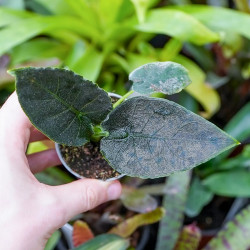
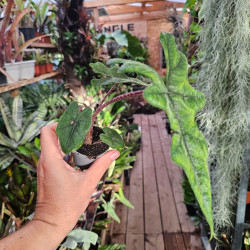
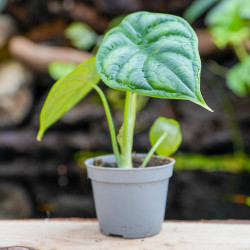
No variegation needed to stand out: Alocasia sp. Sulawesi 'Green Carpet' turns deep green foliage into a true three-dimensional feature. Its thick, heavily quilted leaves appear almost sculpted, with texture becoming increasingly dramatic as the plant matures. A striking choice for collectors who appreciate unusual botanical forms.

Security policy


Satisfaction guaranteed or your money back
 Free shipping on orders over €59
Delivery throughout Europe in 48 hours.
Alocasia sp. Sulawesi 'Green Carpet' is a distinctive collector tropical aroid prized for its thick, deep green and heavily textured foliage. The leaf surface develops a dense quilted relief, giving rise to the evocative horticultural name “Green Carpet”.
Compact, graphic and still relatively uncommon in cultivation, this Alocasia brings a distinctly wild and sculptural character to tropical collections, large humid terrariums and emerged paludarium displays.
Araceae
Alocasia
Alocasia sp. Sulawesi 'Green Carpet'
The plant is currently traded as Alocasia sp. Sulawesi 'Green Carpet'. As its precise identification to a formally published species has not been clearly established, JungleBox retains the designation “sp.” rather than assigning an unsupported species name.
This form is associated with Sulawesi, Indonesia, an island exceptionally rich in Alocasia species adapted to humid tropical forest environments.
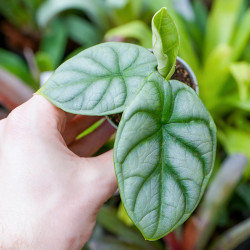
The leaves are thick, leathery and strongly quilted, with colour ranging from rich green to very deep green.
The leaf blade develops a pronounced network of depressions and raised areas that gives the foliage an almost sculpted appearance.
Texture is the defining feature of 'Green Carpet'. Juvenile foliage may initially appear smoother, while the characteristic relief usually becomes more pronounced as the plant matures.
Alocasia sp. Sulawesi 'Green Carpet' has a compact upright growth habit. New leaves emerge from the base and gradually form a dense clump.
Under good conditions, it remains relatively restrained compared with many larger Alocasia species.
Use a highly aerated and free-draining aroid mix containing coco chips, fine bark, perlite, sphagnum moss and light organic material.
The growing medium should retain light moisture without becoming compact or permanently saturated.
Keep the substrate lightly moist during active growth, allowing the upper layer to begin drying before watering again.
Avoid excessive watering and stagnant moisture around the root system.
Humidity of approximately 65% to 85% is particularly suitable.
High humidity encourages healthy leaf development, but adequate airflow remains essential.
Ideal growing temperature: approximately 20°C to 28°C.
Avoid prolonged cold conditions and cool draughts.
Alocasia sp. Sulawesi 'Green Carpet' prefers medium to bright filtered light.
Good lighting encourages compact, richly coloured and strongly textured foliage. Avoid harsh direct sunlight.
Slow to moderate growth.
Successive leaves may develop increasingly pronounced texture as the plant matures.
Like other Alocasia, mature plants may produce typical aroid inflorescences consisting of a spathe and spadix.
Its primary ornamental feature remains the strongly textured foliage.
Propagation is mainly carried out by separating offsets or small corms produced around the root system.
Remove only old or heavily damaged leaves and avoid unnecessary handling of new foliage while it is unfurling.
Maintain good airflow and pay particular attention to excessive moisture around the crown and roots.
Use a balanced low-strength tropical plant or aroid fertiliser during active growth.
Light regular feeding is preferable to highly concentrated applications.
This Alocasia does not rely on variegation for impact: its entire appeal comes from the extraordinary relief of its foliage. Deep green leaves appear almost sculpted, giving the plant a strong and instantly recognisable character.
It is particularly attractive to collectors looking for unusual botanical forms rather than conventional variegated plants.
Provide bright filtered light and a highly aerated substrate. Avoid pushing rapid growth with excessive watering or fertiliser: steady growth generally produces thicker and more strongly textured foliage.
Like other Araceae, Alocasia plants contain calcium oxalate crystals. The sap may be irritating and the plant should not be ingested.

You might also like
No variegation needed to stand out: Alocasia sp. Sulawesi 'Green Carpet' turns deep green foliage into a true three-dimensional feature. Its thick, heavily quilted leaves appear almost sculpted, with texture becoming increasingly dramatic as the plant matures. A striking choice for collectors who appreciate unusual botanical forms.