- New


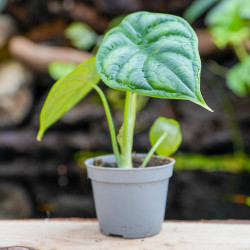
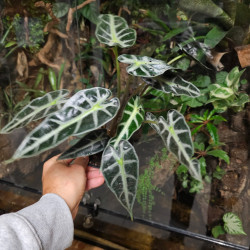
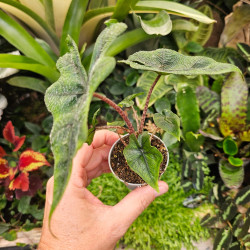
An Alocasia that truly seems to dance: 'Tiny Dancers' carries small green leaves on long, slender, arching petioles, creating a light and animated silhouette. Compact and very different from traditional large-leaved Alocasia, it adds a distinctive graphic touch to tropical collections and displays.

Security policy


Satisfaction guaranteed or your money back
 Free shipping on orders over €59
Delivery throughout Europe in 48 hours.
Alocasia 'Tiny Dancers' is an unusual tropical hybrid aroid with a remarkably light and graceful growth habit. Unlike traditional Alocasia with large, heavy leaves, it produces small green leaves held on long, slender, arching petioles, creating an almost dancing silhouette.
Compact, elegant and distinctive, it is particularly attractive in aroid collections, tropical displays and sufficiently spacious terrariums where its airy form can be fully appreciated.
Araceae
Alocasia
Alocasia 'Tiny Dancers'
'Tiny Dancers' is a horticultural hybrid resulting from Alocasia brisbanensis × Alocasia odora.
Alocasia brisbanensis × Alocasia odora
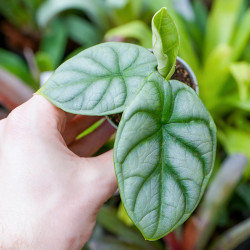
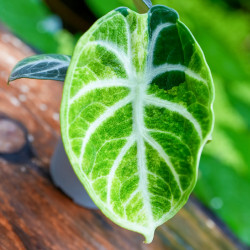
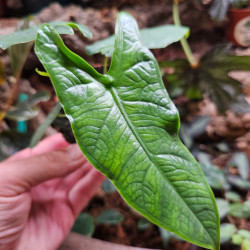
The leaves are relatively small, green and carried on long upright to slightly arching petioles.
Their unusual shape, often resembling a small heart or raised cup, contrasts strongly with the large arrow-shaped foliage normally associated with Alocasia.
Alocasia 'Tiny Dancers' develops an upright, light and airy habit. Its slender petioles give the impression that the leaves are floating above the substrate.
It remains more compact than many species and hybrids while gradually developing into a dense, highly graphic clump.
Use a light, highly aerated and free-draining aroid mix containing coco chips, fine bark, perlite, sphagnum moss and light organic material.
The substrate should retain light moisture while allowing plenty of airflow around the roots.
Keep the substrate lightly moist during active growth, allowing the surface to begin drying between waterings.
Avoid permanently saturated growing media and stagnant moisture around the crown.
Humidity of approximately 60% to 85% is particularly suitable.
Humid air supports steady leaf development, provided adequate airflow is maintained.
Ideal growing temperature: approximately 20°C to 28°C.
Avoid prolonged temperatures below 16°C and cold draughts.
Alocasia 'Tiny Dancers' prefers bright filtered light.
Good lighting encourages stronger petioles and compact growth. Avoid harsh direct sunlight.
Moderate to relatively fast growth under warm, bright and humid conditions.
The plant can regularly produce new leaves from the base during active growth.
Like many Alocasia, 'Tiny Dancers' may slow considerably or lose some foliage when temperatures or light levels decrease.
Reduce watering during this period until active growth resumes.
Mature plants may produce typical aroid inflorescences consisting of a spathe and spadix.
Its main ornamental feature remains its unusual airy foliage and growth habit.
Propagation is mainly carried out by separating offsets or small corms produced around the mother plant.
Remove only old or damaged foliage at the base.
Avoid excessive handling of the long slender petioles, which are an important part of the plant's distinctive appearance.
Use a balanced low-strength tropical plant or aroid fertiliser during active growth.
Reduce feeding when growth slows.
'Tiny Dancers' completely breaks the usual Alocasia silhouette: instead of massive foliage, it produces slender stems topped with small leaves that seem to float and dance above the pot.
Its airy structure adds movement and lightness to tropical displays while retaining the unmistakable character of the Alocasia genus.
Provide bright filtered light to encourage sturdy petioles and compact growth. In terrariums, avoid positioning the plant directly beneath a misting nozzle and allow enough space around it to fully appreciate its airy silhouette.
Like other Araceae, Alocasia plants contain calcium oxalate crystals. The sap may be irritating and the plant should not be ingested.

Specific References
You might also like
An Alocasia that truly seems to dance: 'Tiny Dancers' carries small green leaves on long, slender, arching petioles, creating a light and animated silhouette. Compact and very different from traditional large-leaved Alocasia, it adds a distinctive graphic touch to tropical collections and displays.