- New


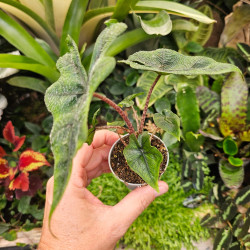
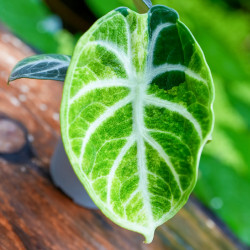
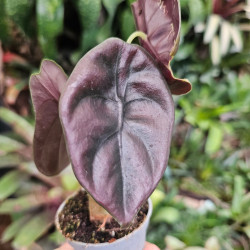
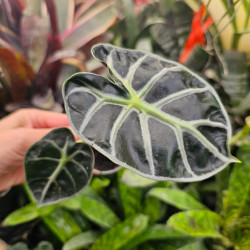
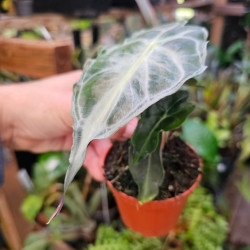
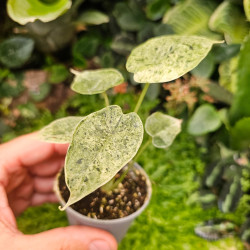
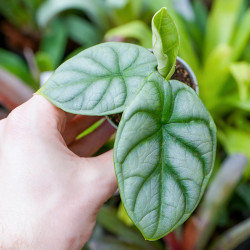
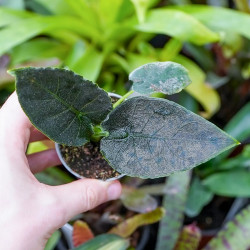
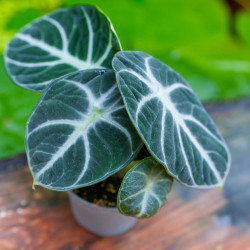
An Alocasia that looks almost carved from stone: Alocasia melo develops thick, rigid and deeply textured leaves in grey-green to dark green tones. Compact yet visually powerful, it adds an almost mineral texture that immediately stands out among more conventional tropical foliage.

Security policy


Satisfaction guaranteed or your money back
 Free shipping on orders over €59
Delivery throughout Europe in 48 hours.
Alocasia melo is a distinctive collector tropical aroid instantly recognisable by its exceptionally thick, rigid and deeply textured foliage. Its grey-green to dark green leaves have a strongly sculpted surface with an almost mineral appearance.
Compact and highly graphic, this species is especially valued by Alocasia and aroid collectors for foliage that looks very different from the large arrow-shaped leaves typical of many other members of the genus.
Araceae
Alocasia
Alocasia melo A.Hay, P.C.Boyce & K.M.Wong
Alocasia melo is native to Sabah, Borneo, where it grows in humid tropical environments.
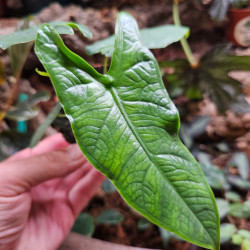
The leaves are thick, leathery and strongly quilted, ranging from grey-green to deep green.
The pronounced relief of the leaf blade creates a network of raised and recessed areas that gives the foliage an almost rocky or armoured appearance.
Texture is the defining feature of this species. The leaves are significantly thicker and more rigid than those of many other Alocasia, with a firm feel and deeply sculpted surface.
Alocasia melo has a compact upright habit. Leaves emerge from a short base and gradually form a dense clump.
Its development remains relatively restrained compared with larger species in the genus, making it especially suitable for compact collections.
Use a highly aerated and free-draining aroid mix containing coco chips, fine bark, perlite, sphagnum moss and light organic material.
The growing medium should retain light moisture while maintaining excellent oxygenation around the roots.
Keep the substrate lightly moist during active growth, allowing the surface to begin drying before watering again.
Avoid excessive watering and permanently saturated growing media.
Humidity of approximately 65% to 85% is particularly suitable.
Humid air encourages healthy foliage, although regular airflow remains important.
Ideal growing temperature: approximately 20°C to 28°C.
Avoid prolonged temperatures below 16°C and cold draughts.
Alocasia melo prefers bright filtered light.
Good lighting supports compact growth and thick, well-formed leaves. Avoid harsh direct sunlight.
Slow to moderate growth.
Successive leaves can become progressively thicker and more strongly textured as the plant matures.
Like many Alocasia, growth may slow significantly when light levels or temperatures decrease.
Reduce watering during this period and gradually resume when active growth returns.
Mature Alocasia melo may produce typical aroid inflorescences consisting of a spathe and spadix.
Its main ornamental feature remains the exceptionally textured foliage.
Propagation is mainly carried out by separating offsets or small corms produced around the root system.
Remove only old or genuinely damaged leaves.
Avoid keeping the crown constantly wet and pay particular attention to overwatering.
Use a balanced low-strength tropical plant or aroid fertiliser during active growth.
Light regular feeding is preferable to concentrated applications.
Alocasia melo does not need variegation to stand out: its entire character comes from texture. Thick, dark green leaves look almost as though they have been carved from stone.
It is a compact yet powerful collector plant, ideal for introducing a very different texture among smoother tropical foliage.
Provide bright filtered light and a highly aerated substrate. This species performs best with steady growth and well-oxygenated roots rather than constantly wet growing media.
Like other Araceae, Alocasia melo contains calcium oxalate crystals. The sap may be irritating and the plant should not be ingested.

Specific References
You might also like
An Alocasia that looks almost carved from stone: Alocasia melo develops thick, rigid and deeply textured leaves in grey-green to dark green tones. Compact yet visually powerful, it adds an almost mineral texture that immediately stands out among more conventional tropical foliage.