- New
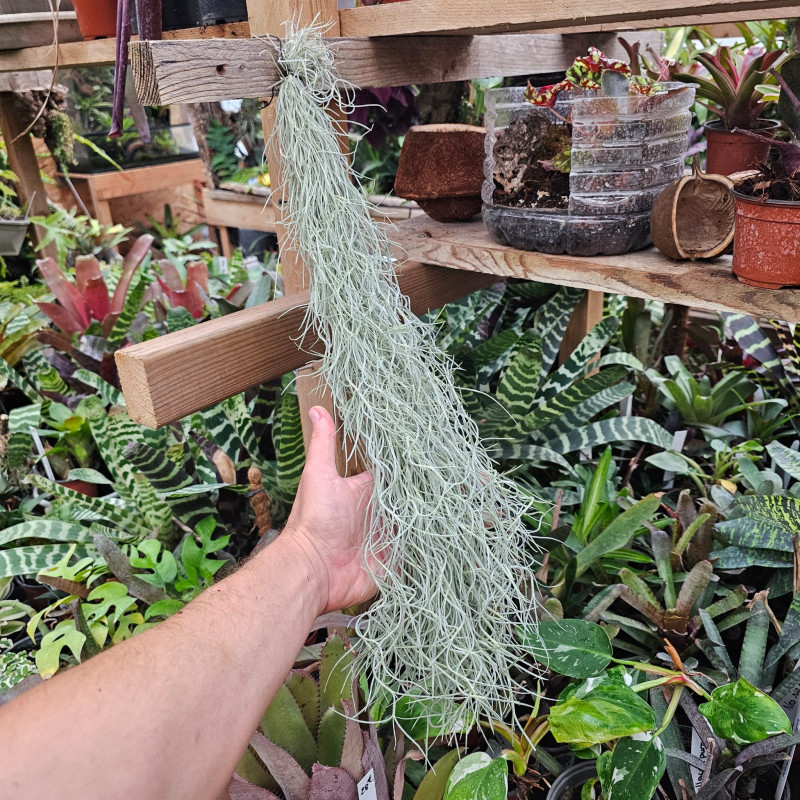
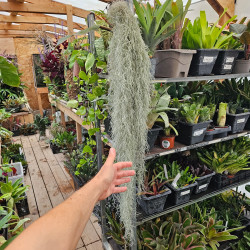
Tillandsia usneoides 50–60 cm, or Spanish moss, is a hanging epiphytic bromeliad with silvery foliage. Ideal for well-ventilated tropical terrariums, paludariums and natural hanging displays on branches or roots.

Security policy


Satisfaction guaranteed or your money back
 Free shipping on orders over €59
Delivery throughout Europe in 48 hours.
Tillandsia usneoides 50–60 cm, commonly known as Spanish moss, is a spectacular epiphytic bromeliad forming long cascades of fine silvery stems. Supplied at approximately 50 to 60 cm long, it is ideal for instantly adding volume and a natural rainforest effect to terrariums, paludariums, greenhouses and hanging displays.
Unlike most potted plants, Tillandsia usneoides does not require substrate. It naturally hangs from tree branches and absorbs moisture and nutrients primarily from the air through the numerous trichomes covering its foliage.
Bromeliaceae
Tillandsia
Tillandsia usneoides
Spanish moss
Length: approximately 50 to 60 cm
Tillandsia usneoides is widely distributed throughout tropical and subtropical regions of the Americas, where it naturally grows epiphytically from tree branches in warm, bright and well-ventilated environments.
The foliage consists of numerous fine, flexible leaves covered with silvery-grey trichomes. Together they form long, lightweight hanging strands.
These trichomes give the plant its characteristic silver appearance and play an important role in absorbing atmospheric moisture.
Tillandsia usneoides has a fully hanging growth habit. The stems gradually branch and can form long masses of vegetation under suitable conditions.
The supplied length of 50 to 60 cm provides an immediate cascading effect.
Tillandsia usneoides is grown without substrate. Simply suspend it from a branch, root, mesh or cork support.
The plant should remain loose and well aerated. Avoid compressing it or placing it in areas where moisture remains permanently stagnant.
No substrate is required.
The plant should be grown suspended or placed on a support that allows excellent airflow.
Mist regularly using soft or low-mineral water.
After watering, the plant should be allowed to dry quickly and completely. Tillandsia usneoides kept permanently wet may decline.
Moderate to high humidity is suitable when combined with very good airflow.
In tropical terrariums, a regular wetting and drying cycle is preferable to permanently stagnant humidity.
Ideal growing temperature: approximately 18°C to 28°C.
Avoid prolonged cold conditions and frost.
Tillandsia usneoides prefers bright filtered light.
Good light encourages denser growth and helps prevent weak, stretched development. Avoid harsh direct sunlight through glass unless the plant has been gradually acclimated.
Airflow is one of the most important aspects of cultivation. After misting, stems and leaves should be able to dry quickly.
In terrariums, position the plant in an area with regular air movement rather than in a permanently saturated corner.
Moderate to fast growth under good light, adequate humidity and especially strong airflow.
The plant can produce small, discreet greenish to yellowish flowers. Although small, they may have a pleasant fragrance.
Propagation is very easy: simply separate a section of the plant and suspend it from a new support.
Remove any dry or damaged sections and avoid allowing organic debris to remain trapped within the strands.
Good airflow and low-mineral water help maintain clean, silvery foliage.
A Tillandsia or bromeliad fertiliser can be used occasionally at very low concentration during active growth.
Avoid strong fertilisation, which can damage the plant’s fine tissues.
Tillandsia usneoides creates an immediate natural rainforest effect thanks to its hanging habit and silvery foliage.
It is particularly useful for decorating the upper sections of terrariums, branches and areas that are difficult to plant with conventional species.
Hang several strands of Tillandsia usneoides at different heights from roots or branches to create a deeper and more natural display.
In tropical terrariums, always prioritise ventilation: high humidity is beneficial only when the plant can dry properly between mistings.

Specific References
You might also like
Tillandsia usneoides 50–60 cm, or Spanish moss, is a hanging epiphytic bromeliad with silvery foliage. Ideal for well-ventilated tropical terrariums, paludariums and natural hanging displays on branches or roots.