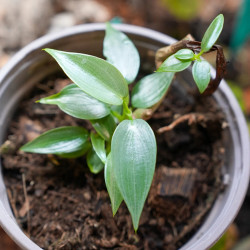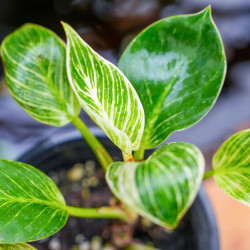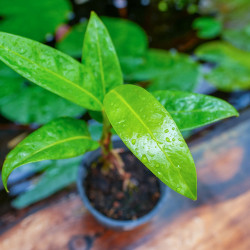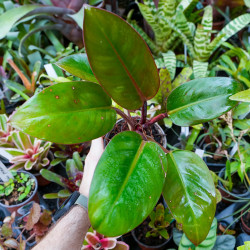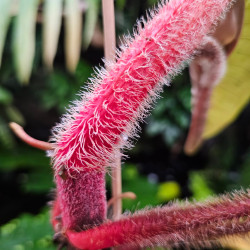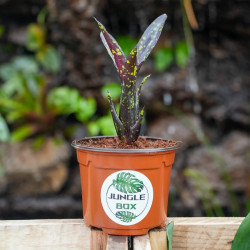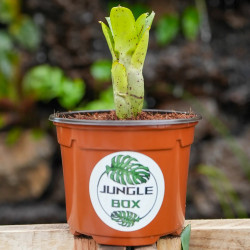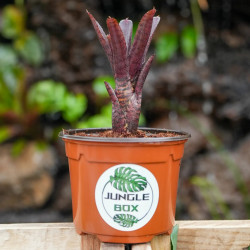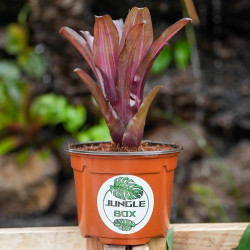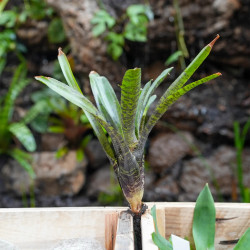


Those orange petioles are impossible to miss: Philodendron billietiae combines long elegant green leaves with golden-yellow to orange stems for an instantly recognisable look. Trained up a root or vertical support, it gradually gains presence and becomes a true centrepiece in any tropical plant collection.

Security policy


Satisfaction guaranteed or your money back
 Free shipping on orders over €59
Delivery throughout Europe in 48 hours.
Philodendron billietiae is a collector tropical climbing aroid instantly recognisable by its long narrow leaves and striking yellow-orange to orange petioles.
Its elongated, slightly pendent foliage gives it an elegant architectural appearance that differs significantly from broad-leaved Philodendrons. It makes an excellent focal plant for large tropical displays.
Araceae
Philodendron
Philodendron billietiae Croat
Philodendron billietiae is native to wet tropical forests of Guyana, French Guiana and northern Brazil, particularly Pará.
In nature, it primarily grows as a climbing hemiepiphyte and may occasionally occur on rocky substrates.
The leaves are long, narrow, leathery and slightly pendent. Mature specimens can develop impressively large leaves while retaining their elegant elongated form.
The leaf blades are typically deep green, while the petioles range from yellow-green and golden yellow to orange.
The colourful petioles are the signature feature of Philodendron billietiae. Their colour may range from greenish yellow to rich orange depending on maturity, light and growing conditions.
This contrast between green foliage and warm-toned petioles gives the plant an exceptionally graphic appearance.
Philodendron billietiae is naturally climbing and develops adventitious roots that allow it to anchor onto trunks, roots and vertical supports.
Mature specimens can become substantial and develop very long leaves, making this species better suited long term to large terrariums, spacious paludariums, tropical greenhouses or climbing cultivation.
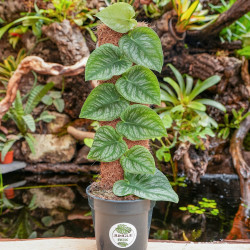
Grow the plant against a substantial natural root, cork panel, moss pole or planted vertical structure.
Vertical cultivation allows adventitious roots to attach and encourages the development of larger, more mature foliage.
Use a highly aerated and free-draining aroid mix containing coco chips, bark, perlite, sphagnum moss and light organic material.
The growing medium should retain light moisture while providing excellent root aeration.
Water when the upper layer of substrate begins to dry slightly.
Avoid permanently saturated growing media and ensure rapid drainage.
Humidity of approximately 65% to 90% is particularly suitable.
Higher humidity promotes foliage and aerial root development, provided adequate airflow is maintained.
Ideal growing temperature: approximately 20°C to 28°C.
Avoid prolonged cold conditions and cool draughts.
Philodendron billietiae prefers medium to bright filtered light.
Good lighting supports compact growth and can enhance the contrast between green leaves and coloured petioles.
Moderate to fast growth under warm, humid conditions with good light and a suitable climbing support.
Mature Philodendron billietiae can produce typical aroid inflorescences consisting of a spathe surrounding a spadix.
In cultivation, however, its main ornamental appeal remains its architectural foliage and distinctive orange petioles.
Propagation is mainly carried out from stem cuttings containing at least one node and ideally an adventitious root.
Train new growth onto its support and remove old or damaged foliage when required.
Provide enough surrounding space for the long leaves to develop naturally without being compressed.
Use a low-strength tropical plant or aroid fertiliser during active growth.
Avoid excessive feeding and mineral salt accumulation.
Philodendron billietiae offers an unusual contrast: elegant elongated green leaves carried on spectacular golden-yellow to orange petioles.
As it climbs over a root or vertical support, it gradually develops a highly architectural silhouette and becomes a true centrepiece in a tropical plant collection.
Provide a vertical support from an early stage and enough room for the long leaves to hang naturally. A substantial root or slightly humid moss pole will encourage adventitious root attachment and mature growth.
Like many Araceae, Philodendron billietiae contains calcium oxalate crystals. The sap may be irritating and the plant should not be ingested.

Specific References
You might also like
Those orange petioles are impossible to miss: Philodendron billietiae combines long elegant green leaves with golden-yellow to orange stems for an instantly recognisable look. Trained up a root or vertical support, it gradually gains presence and becomes a true centrepiece in any tropical plant collection.