- New


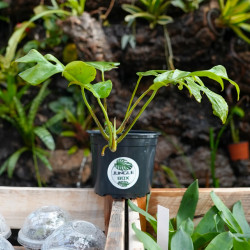
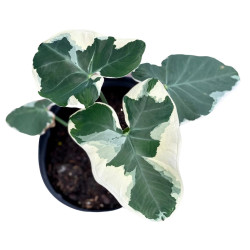
A starry sky in plant form: Monstera 'Thai Constellation' covers its green leaves with countless creamy flecks, with no two leaves ever looking exactly the same. Supplied in a 6 cm pot, this young collector plant will gradually develop the spectacular split and perforated foliage of a mature Monstera.

Security policy


Satisfaction guaranteed or your money back
 Free shipping on orders over €59
Delivery throughout Europe in 48 hours.
Monstera deliciosa 'Thai Constellation' is a highly desirable collector tropical aroid, instantly recognisable by its green foliage scattered with countless cream to off-white flecks. This distinctive pattern resembles a starry sky, inspiring the name “Thai Constellation”.
Supplied in a Ø 6 cm pot, this young plant offers all the appeal of a variegated Monstera in a compact format. It can be established on natural roots, cork, moss poles or vertical planted backgrounds before developing into a much larger specimen.
Araceae
Monstera
Monstera deliciosa
Monstera deliciosa 'Thai Constellation'
Ø 6 cm
Monstera deliciosa is native to tropical forests from Mexico to Guatemala, where it naturally grows as a climbing vine and hemiepiphyte.
'Thai Constellation' is a horticultural cultivar selected for its distinctive cream variegation.
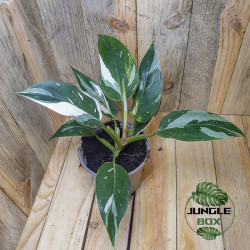
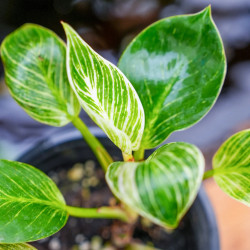
Young leaves are generally entire, green and irregularly speckled with cream to very pale yellow.
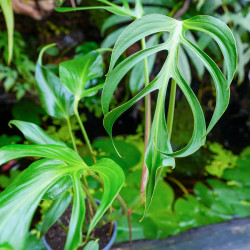
As the plant matures and climbs, it gradually develops larger leaves with the deep splits and perforations characteristic of mature Monstera deliciosa.
The characteristic variegation usually appears as numerous cream flecks, splashes and marbled markings scattered across the leaf blade.
Some leaves may also develop much larger pale sectors, making every new leaf visually different.
Monstera deliciosa 'Thai Constellation' is naturally a climbing plant and develops aerial roots that allow it to attach to trunks, roots and other vertical structures.
Growth is generally slower than in fully green Monstera deliciosa, although mature plants can eventually become very large. The 6 cm pot offered here therefore contains a young specimen.
Grow the plant against a substantial natural root, cork panel, moss pole or planted vertical background.
Vertical cultivation encourages aerial roots to attach and promotes the gradual development of larger, more mature foliage.
Use a highly aerated and free-draining aroid mix containing coco chips, bark, perlite, sphagnum moss and light organic material.
The growing medium should retain light moisture while allowing plenty of air around the roots.
Water when the upper layer of the substrate begins to dry slightly.
Avoid keeping the roots permanently saturated and do not allow water to remain stagnant around the root system.
Humidity of approximately 60% to 85% is highly suitable.
Higher humidity encourages aerial root development but should always be combined with adequate airflow.
Ideal growing temperature: approximately 20°C to 28°C.
Avoid prolonged cold conditions and cold draughts.
Monstera 'Thai Constellation' prefers bright filtered light.
Good lighting encourages compact growth and highlights the cream variegation. Pale areas contain less chlorophyll and are therefore more sensitive to harsh direct sunlight.
Moderate growth, generally slower than a fully green Monstera deliciosa.
Climbing cultivation, good lighting and stable temperatures gradually encourage larger and more mature foliage.
Mature plants can produce typical aroid inflorescences consisting of a spathe surrounding a spadix.
In indoor and terrarium cultivation, however, the main ornamental value is the spectacular variegated foliage.
Propagation is mainly carried out from stem cuttings containing at least one node and ideally an aerial root.
Guide new growth onto its support and remove old or damaged leaves when necessary.
Cream areas may brown more readily than green tissue when humidity is too low, lighting is excessive or watering is irregular.
Use a low-strength tropical plant or aroid fertiliser during active growth.
Avoid excessive feeding, particularly while the plant is still growing in its small 6 cm pot.
Every leaf resembles a miniature constellation, with deep green foliage scattered with hundreds of creamy stars and splashes.
The young 6 cm size also lets you watch the plant transform from compact juvenile foliage into the large, split and perforated leaves that make mature Monsteras so spectacular.
Provide a vertical support from an early stage. A slightly humid natural root or moss pole will encourage aerial root attachment and help the plant transition towards larger, more mature foliage.
Like many Araceae, Monstera deliciosa contains calcium oxalate crystals. The sap may be irritating and the plant should not be ingested.

Specific References
You might also like
A starry sky in plant form: Monstera 'Thai Constellation' covers its green leaves with countless creamy flecks, with no two leaves ever looking exactly the same. Supplied in a 6 cm pot, this young collector plant will gradually develop the spectacular split and perforated foliage of a mature Monstera.